Saturday, December 31, 2011

The Long Haul


My first impressions were – you’re too big, too fat, you’re carrying way too much weight and there’s no way you’re going to move.  No, I wasn’t surveying the damage done by seasonal indulging but looking at the shiny new Qantas A380 that was going to transport me back to Australia for yet more seasonal indulgence.  I’ve made the longest of long haul journeys so many times now to have become almost blasé about the whole thing. Of course there is always a pang of excitement when stepping aboard a plane ready for another adventure.  While there is glamour to traversing the globe in a matter of hours the truth is for those of us consigned to cattle class there isn’t much in the way of glamour.  In fact after the excitement of take off you really need to put your head down and just get through the next 20 odd hours of transit.

Australians are used to the notion of long transits (it takes about 5 hours to fly from one end of the country to the other) and being so far away from anywhere you know that most trips are going to take the best part of a day.  To most of the Europeans I have met the thought of more than four hours in a plane is an unendurable endeavour.   It’s by no means fun but it’s really not that bad if you prepare and after twelve years of travelling between hemispheres I've got this long haul thing down to an art.  What type of book to choose, what clothes to wear, and given that upgrades are as rare as hen’s teeth, where the best spot in the economy cabin is.  In a strange way I actually look forward to the flight as my life is usually so hectic and disorganised that the enforced sitting and doing nothing for twenty hours is a welcome break.  

I have often thought how the act of travelling is a state of mind and atmosphere all of its own.  Over the years I have been through many airports (I think about 30) and the atmosphere in them is always the same.  Once you get past the security check to the airside it feels as if you have already left whichever country you are in and entered the country (or absence of country) of travel.  The transit lounge is full of people waiting wearily for the time to board the aircraft that will take them to an exotic location or back home to familiar surrounds.  Duty free is full of the same bottles of Bombay Sapphire and Chanel No5 that you saw at the point of departure.  There is always the one store stocked full of things that supposedly reflect the culture of the country you have just been in – Harrods in London, Ken Done and boomerangs in Aus, leather and dulce de leche in Argentina, and so on.

Once finally up there in the atmosphere looking down at the world below the clouds I can’t help but imagine that the plane has somehow escaped time.  That by merely taking off and joining the system of invisible airborne highways and byways, that are unmarked save for beacons planted in the middle of nowhere, has taken us out of the earth bound concerns of morning, afternoon and evening; of going to work and what to cook for dinner. Up there all that matters are hours; how many since take off and more importantly how many to your destination.  Watching the oversize plane make its painfully slow progress across the onscreen flight path becomes a small obsession.  The little plane flies over such exotic places as Tashkent and Samarkand that I long to set down in these mysterious places to explore.  At times plane travel seems brutal in picking you up in one place and setting you down on the other side of the world with not a thought to the wonderful places in between.  I’ve long harboured a dream of travelling over land from Spain to China, making the trek from Mediterranean through Central and Eastern Europe across the point where Europe and Asia meet and then over the steppes of central Asia and into South East Asia.  I’m curious to see if I notice the faces, food and cultures changing or if they gradually blend from one into the other – one day perhaps I'll  get round to it.

When at last you do set down in your destination you have to then recover from the flight and the fact that you have gone from one time zone and season to the opposite.  A swim and a shower in my experience is the best way to get over the flight as for jet lag, well that takes a bit of effort.  According to the experts you need to give a day for each hour of difference to come to terms with the new time but for me that’s way too long. The only effective solution I have found is just to force yourself to stay awake until a time deemed reasonable for sleep in your new location.  It’s tough for a couple of days but then you’re right.
    
So very suddenly I am back on the other side of the world in Australia and back in Melbourne.  Back in familiar surrounds where beer comes in pots, people smile and the footy (Aussie Rules of course) is a religion.  There have been reunions aplenty with more yet to do.  As I write this looking out the window at the brilliant sunshine listening to the comforting sound of a tram trundling past I wonder about my funny little life in Treviso half a world away – I wonder if my life in Treviso even exists.   

Monday, December 19, 2011

I give up


It’s a micro climate I’m told, the strange combination of factors that has resulted in this part of the world being meltingly hot in the summer and blisteringly cold in the winter with ridiculous levels of humidity throughout the year.  The hot and humid weather never really bothers me but cold is something I live in fear of.  Get temperatures into single figures and I become the kind of person that lives up to the whinging stereotype that me adopted home holds of British people.  Winter in the Veneto has always been this looming event whose inevitable arrival I have dreaded.  Not just for the cold and humid temperatures that bite through you or the bitter winds that smack you in the face but the knowledge that I can either suffer stoically through the event or start dressing for the weather.  And here lies the problem.

Melbourne gets pretty cold and normally the arrival of the winter months is seen as a opportunity and I look forward to the twice yearly ritual of the wardrobe turnaround when you put wash and put away the t-shirts and summer dresses and pull out the jumpers and thick socks that you haven’t seen for the last five or six months.  I see the cooler months as an opportunity to dress better given that you are required to wear so many more clothes.  When I say Melbourne gets cold I mean Melbourne gets cold for Australia and here with the ever lowering thermometer suddenly my winter clothes look stupidly thin.  Recently everyone seems to be concerned with my preparedness to cope with a Trevisan winter.  I’ve often been asked if I have a warm coat and you know I actually thought I did.  But of late my usual Melbourne winter coat while being ultra stylish in its modern minimalist aesthetic is proving painfully inadequate and I have been forced to consider alternatives. 

When the first signs of cold weather appeared Trevisans en masse (I’m not sure if there is a set date for this or if the Trevisans have some kind of sartorial telepathy) pulled out their puminos.  A pumino is a big puffy, padded coat that while keeping you snug does run the danger of making you look like the Michelin man.  For a while it seemed as if every shop window was full these monster coats.  If like me you don’t particularly like the pumino there is a popular alternative – fur.  Here there doesn’t seem to be any stigma or controversy about wearing animal pelts and I’ve never seen so many women in fur.  Now obviously I’m not going to wear fur so it looks like the pumino is my only option if I’m going to get through the winter.  Unfortunately being short (I make pygmies look tall) and svelte not being an adjective you would use to describe me I look pretty stupid in one of these big puffy numbers.  I also think they’re pretty ugly so the prospect of owning one is quite distressing. 

Winter 2011/2 Big, puffy coat and gumboots
Get one, wear it through the winter and then put it at the back of your wardrobe and forget about it until you need it again was the advice I was given and it was with this in mind that I went out in search of a pumino.  I quickly realised that if I was to be warm I would have to give up any notions of style – these coats just look stupid on me.  They’re not cheap either and when push came to shove I couldn’t face the thought of spending 100+ euros on something that made me look like a cross between the stay puft marshmallow man and a sleeping bag.  I’ve never really thought of myself as a fashonista preferring to dress for comfort and mood rather than the latest trends yet I surprised myself by being prepared to suffer the cold to avoid the marshmallow look.  That was until the temps really started dropping and I soon realised that I am prepared to sacrifice a bit of style to the greater good of being warm.  I was hoping to ride it out until the sales kicked in post Christmas but no luck, it’s just too cold to wait.  Still being tight fisted or prudent enough not to spend my hard earned money on something that will render me a visual joke I’ve borrowed one from M.  Yes it’s super warm and puffy and yes I am giving up on style – for the next few months at least.

Sunday, December 11, 2011

He was only a cruise ship crooner


the award for headline of the year goes to The Daily Telegraph


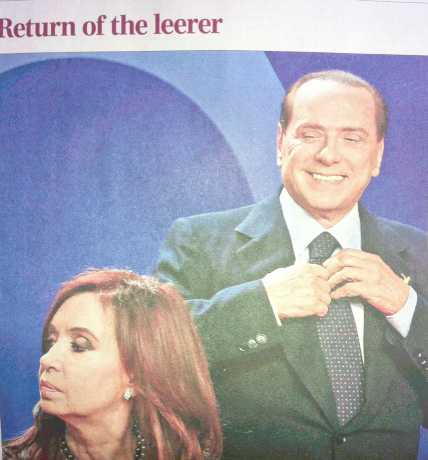
Since my acquaintance with this country a certain Mr B has dominated the political landscape, so much so that it seems strange to think he’s no longer there.  While many an Italian was rejoicing at the demise I wonder if the countries satirists were thrown in a pit of despair at the loss of such a rich vein of material.  But then again Mr B had become such a parody that there really was no need to add satire.

I have always wondered how Italians came to elect (three times) a man for whom the word buffoon seems to have been invented.   Italian politics are a complicated and opaque world and certainly not one that I can begin to sum up in a superficial blog nor would I have the arrogance to suggest I am qualified to do so.  Given that he first came to power after the reigning government was exposed as having its hands in so many tills that the prime minister fled the country perhaps he did seem like a breath of fresh air.  The fact that he owns several television stations and newspapers did help PR matters.  Or were the Italians seduced by the narrative of the vacuum cleaner salesman and sometime cruise ship singer pulling himself up to be a media mogul and one of the richest men in the country?  Who can blame them for thinking that maybe some of that magic would rub off but once in power things where a different matter.   There’s a quote attributed to Pope Leo X which I’m often reminded of when I think about Mr B and his time in office.  From his seemingly endless partying, appointing a string of MPs whose main qualification for the job was a pretty face and breasts, to the changing of laws to suit his business interests or avoid prosecution the cynicism of Pope Leo to me perfectly sums up the last few years of Italian political life - "Since God has given us the Papacy, let us enjoy it." – substitute a couple of words and I think you’ll have it.   

Once in power and, at least in my opinion, showing himself to be at best hopelessly inadequate and at worst corrupt he was voted back twice to form the longest serving Italian government since Mussolini.  Why?  You could argue it was a lack of an effective opposition or it could be the appeal to self interest or did all the favourable media coverage lead the country to think he was doing a good job?  Well the reason was – Oh hell search me I have no idea, it really is mind boggling that he was voted in once let alone three damn times.       

At the end of it all Mr B wasn’t brought down by any one of the number of personal, political or business scandals that became so common that one didn’t even raise an eyebrow but by the enormity of the European financial crisis.  Once the crisis turned towards Italy his demise was swift, watching his leaving I got the impression that B is genuinely bewildered as to how events turned against him.  From being the astute media player suddenly the populist touch deserted him.  Many Italians were angered by his glib assertion that everything was ok as the bars and restaurants of Italy were full without a mention of the growing hardships caused by austerity measures.  B has left the country with one hell of an overdraft, rising unemployment and the (temporary) suspension of democracy – the current and polar opposite Prime Minister Mario Monti was appointed to the position by the president.  The country like much of Europe is in a mess and one that will most likely get worse before (if) it gets better.

As for Mr B have we seen the last of him?  Will he be happy to retire to his villa or is he plotting a return.  He has kept himself busy releasing an album of co-written love songs just a week after leaving office.  Given that now he is out of power his immunity from prosecution has gone and that his party is still the biggest in Parliament it’s hard to believe this is the end of him.  I personally don’t think it will be too long before the perma tan returns – just long enough for the public to blame the current government for the continued economic hardship that’s my guess.  “Men are so simple and so much inclined to obey immediate needs that a deceiver will never lack victims for his deceptions. Machiavelli
            

Sunday, November 6, 2011

Crash, Bang, Wallop


This week I’ve been asking myself do different nations hear differently?   No I haven’t been listening to the Italian charts (although whenever I am unfortunate enough to catch the latest top ten hit I do wonder if a large percentage of the Italian population is tone deaf – but I also I wonder that whenever I’m confronted with the fact that Coldplay have a career.)  When travelling through various countries one of my personal joys has always been the different languages I have encountered and the little tricks I’ve gathered to cope – whilst navigating the Japanese transport system I quickly learnt to match the symbols on my ticket to the departures board with not a single mishap, when in a little town in the Tamil speaking part of India meeting a local who spoke no English and me only speaking Panjabi, of the multitude of Indian languages, we found that we could communicate in Italian of all languages.  As well as dealing with the new words and grammatical constructions there is the host of vocal and onomatopoeic sounds that make up a language.  While I expected words to be different I never really gave a thought to the onomatopoeia. 

In the UK and Aus (I hasten to add other English speaking Countries) the onomatopoeic word for a dog bark is woof, here dogs don’t woof woof they bau bau! Birds don’t go cheep cheep they cip cip and frogs don’t ribbit they cra cra.  It’s not just the world of animal sounds that are different, if an English speaker cuts their finger they will exclaim ouch or ow an Italian will say ahi or ahia as they apply pressure to the injured digit.  Crack a joke to a native English speaker and you will hopefully hear  ha ha or hee hee try to be funny in Italy ah, ah, eh, eh, ih, ih, or uh, uh is what your ego will be wanting to hear. Tuck into a Raji curry and yum yum or om nom nom is what I want to hear from an English speaker and gnam gnam from my Italian friends.  When it comes to bodily functions once again we are in a linguistically different world, an English speaker will fart or burp and an Italian will prot and rutt respectively.  Hearing brrrring will have me leaping for the phone and Italian will only do so if he hears a drin drin.  I knock on a door while my Italian chums toc.  In Australia my floorboards would creek here they cric crac.

These onomatopoeic sounds seem so hard wired and often come from instant emotions that I cannot believe that I would ever be able to make them part of my lexical repertoire.  Yet when I talk to my long term expect friends I’m amazed that they do make the Italian exclamation when in pain, or just generally pissed off while driving.       

These differences while unimportant do make me wonder, do we hear sounds differently or is it just out different languages that result in the divergent interpretations?  The Japanese language has no L sound and Japanese speakers have great difficulty in identifying and pronouncing when speaking English.  Studies have shown that as newborns Japanese children can hear the L sound but as they grow and the brain develops to acquire language skills they lose the ability to identify the sound due to not hearing it spoken.  Does this explain why different nations interpret the same sound differently?  One theory of linguistic development argues that language developed from early humans making onomatopoeic words from the sounds around them.  I’m way to ignorant to speculate on such things but this week once again I have been reminded what an amazingly rich, complex and beautiful beast language is.          

Monday, October 31, 2011

Not in Kansas now


One of the little pleasures I’ve always gotten from travelling is experiencing the many differences between the new place and my usual habitats.  Of course you expect the big things: language, driving on the other side and wasting a good portion of your life in a Kafkaesque bureaucracy but there are many little things that while generally not better or worse are just plain different.  So today I thought I would regale you with some of the little differences that I didn’t expect to find:

People don’t read on trains: being a not infrequent train traveller I have had much time to observe Italian train customs and unlike their British or Australian counterparts the Italian commuter does not have his head buried in a paperback (or more recently an ereader.)  Whenever I have taken a journey, be it a long haul flight from Aus to Britain or just a short tram trip to work I’ve taken the opportunity to get a couple of chapters read (and as I was generally taking the 86 or 57 tram it was also a good way to avoid any accidental eye contact with a junkie or general crazy person) here people seem content to stare out the window.

Table of contents are at the back of the book just before the index: a little trifling matter but being used to the whole; front cover, dedication page, table of contents, main text, bibliography and finally index the Italian (not sure about other countries, please feel free to enlighten me) tradition of having the contents page at the back threw me a bit.  Yes, I do find it strange to read the book, get to the end and then find the page telling what’s in the book but there you go – if anyone can tell me why it’s like that I would love to know. 
     
It’s not just driving on the right people walk on the right too: It seems that whichever side of the road a nation drives on they will walk in the same manner – never noticed this before.  Now I’m used to the left and here people drive and walk on the right.  As you might expect this causes quite a few occasions where I have to get out of the way of someone who is adhering to the correct pedestrian etiquette.  Unfortunately I am also used to stepping aside to the left and the Italians to the right thus resulting in moments of endless polite shuffling as we both try to get out of each others’ way and continue on ours.

Plastic bags:  at my local supermarket I am no longer asked if I want a plastic bag. I’m one of those people who brings my own cloth bag.  I am very much in the minority but at least there is an effort to discourage plastic bag use by way of a 10c charge.  When it comes to the fruit and veg aisle I find myself despairing.  Let me state my position these items do not need a plastic tear if you even look at it bag:  a whole pumpkin – it comes with its own protection,  a single apple or any other single fruit, ginger; that skin will do more than the plastic.  While I’m on the rant if the fishmonger has put your salmon fillets or whatever in a plastic bag, then wrapped the whole thing in paper and then kindly placed the package in a carrier bag you do not need to tie the handles together and put that bag in yet another bag.
    
Toasters: Italian toasters don’t pop up.  Instead of the pop up mechanism you have to put your bread in a metal clamp like contraption and lower it into the toaster. Not better or worse just different.

The concealed drip rack: the most glorious difference, to me one of the greatest inventions and why the hell has no other country I have had the pleasure to experience got one in their kitchen?  No longer do my dishes sit on the work surface taking up valuable space and endlessly reminding me that they need to be put away.  Now they are carefully concealed above the sink, not asking to be put away but waiting happily until I have call to use them again.  Honestly I do not wish to work in a kitchen without one ever again.  That and the marble worktops which now mean I no longer find myself in the situation where I’m holding a red hot tray straight out of the oven, burning my fingers because I couldn’t be bothered to find the oven gloves and am using a tea towel that’s barely adequate all the while poncing around looking for the damn trivet.  

The concealed dish rack, a genius idea


Monday, October 17, 2011

Views from the bottom of the glass


Make a list of the things Italy is famous for you would have to include:  Food, fashion, a prime minister that makes Caligula seem like the quiet bookish type and of course some of the world’s finest wines.  This week I’ve been musing (and gathering data in the field) over the difference between the drinking cultures here and the ones I’ve experienced.  I make no secret of the fact that I like a drink, be it wine, beer, port, whisky, gin, vodka (especially that yummy polish Bison grass one) and thanks to a couple of visits to South America I’ve even revived a love for tequila after one bad night when a student and  17 intervening  years.  I like the taste of a deep red, the crispness of a white the yeastiness of beer and I need to stop before I get lost in a train of thought more appropriate to Oz Clarke than a blog about Italy.   

It’s no surprise to say that the drinking culture here is very different.  The first thing I noticed was how different points of an evening are marked by different drinks.  The early evening is spritz time, with food it’s wine and after coffee one of a seemingly endless list of digestives.  The Italians make an array of ridiculously delicious wines and since my arrival I have come across many a new variety of grape.  Alcohol is also much cheaper meaning a good bottle of wine doesn’t have to be an investment and with the average drink in a bar costing 2 euro, a night out is not an expensive prospect.  From what I’ve seen all this cheap booze does not result in much public drunkenness.  In my time here I haven’t really seen any from the locals (the expats are a different matter) and it’s been a relief to not have to deal with the attentions of an over imbibing male – yes I mean Ted.  On Saturday night a gang of us headed out to the annual fair for the evening.  Amongst the dodgems, shooting galleries and food stalls there were a liberal number of drinking venues.  T noted that had this been the UK there would have been at least one drunken altercation and a lot of booze fuelled bumper car driving.  As it was people were just enjoying a glass of wine with their roast chestnuts or a beer with their barbequed sausage and despite getting home near 3, I woke up the next morning without a trace of a hangover. 

The prodigious drinking that seems to characterise nights out in the Anglo countries is frowned upon here.  One night while out with some Italian friends a member of the party commented on how much I drank as sipped a post dinner digestive – it was my fourth drink in about as many hours.  While at times I find this aspect of the culture uptight it is nice to be able to savour the taste of a really beautiful drink and not have worry about losing the best part of a day to feeling like a bar room floor.  My friends here have fallen into two camps – those that don’t really drink and those that like to party.  I know that a night out with the moderate drinkers will most likely include a comment about my taking a second glass of wine and as for the other group (especially if M and T are involved) that needs a good self preservation instinct.  
  
In Aus and the UK drinking is very much a social lubricant, you’ve something to celebrate you have a drink, you’ve had a bad day you need a drink, you’re feeling a bit meh so you have a drink, you need a bit of Dutch courage – yep, you guessed it.  The social culture in these nations is revolved around pubs and bars.  Often these places become second homes and for me who has spent the last 12 years away from family I’ve found the atmosphere of a friendly local essential to keeping the spirits (pun half intended) up.  That's not so different here the bars are all full of a Friday evening and every occasion seems to be punctuated with the raising of a glass.  The big difference is that no one seems to need to medicate themselves to the point of oblivion.  I’ve often wondered what it is about the culture in the UK and Aus that has us drinking to the point of cognitive failure – not that we are unique.  Whilst in Japan I lost count of the number of Japanese salarymen I saw getting wasted in a post work bonding session.  Here I’m enjoying the emphasis on quality rather than quantity and as ever the sharing of a drink in the company of wonderful people.     

Monday, October 10, 2011

Bamboccioni


I grew up in a small Hampshire village and for as long as I can remember I was itching to leave the place.  There was a wider world out there and I wanted to be part of it.  Like many of my friends I couldn’t wait to “grow up” and branch out on my own, which to me meant leaving the constraints of the parental home, being independent and learning to rely on my own resources.  This rite of passage happened at 18 when I left home for University in London.  When I left I’m sad to say I never really gave a thought to how my parents would feel, two older sisters had already moved out and I could assuage any empty nest guilt as my much younger brother was still there to keep my mum occupied (something he was doing very well.)  I never moved back (aside from a few months between overseas stints.)  Most of my friends have similar stories with the need for independence and the stretching of wings resulting in leaving home somewhere around the late teens or early twenties. 

Recently I came across this article (http://www.bbc.co.uk/news/world-europe-14995588) which got me thinking about things here.  A few months ago a student was telling me about how he had recently split from his girlfriend and was hunting for an apartment.  I assumed that this heartbroken man (in his early thirties) was living with his girlfriend when the relationship foundered.  It was only later that I learnt that he, despite have a seriously good job, was still living with his parents (he also hadn’t split up with the girlfriend but I’ll leave that whole thing for another time.)   Once he did move out there was a litany of stories of his various domestic disasters that it quickly became clear that his mum really did everything for him. 

Their called bamboccioni (overgrown babies) those that continue to live in the parental home long into adulthood – the term was coined by a government minister who admits he didn’t learn to make a bed until he was 30, when he left home.   Many of my friends and students still live in the parental home well into their 20s and 30s.  EU statistics (yes I’ve done my research) show a whopping 64% of Italian 18-35 year olds still live in the family home (21% in Germany.)  The average age for moving out of home here is 36 (a good 18 years after me.)  When I ask Italians about the reasons for the late nest flying one of the first things mentioned is the high unemployment and the cost of setting up on your own.  Both these issues cannot be refuted.   The average wage in Italy is half that of that UK (these stats may be a bit out of date now.)  Having said that according to the Institution of population research of those 20-35 year olds in employment 45% still chose to live at home.    As for costs, setting up on your own is a pretty pricey endeavour which is why I and most of my peers shared homes and split costs but the culture of share accommodation doesn’t seem to exist here.  When I’ve mentioned it to people I’ve usually been met with horrified looks.  Why would I live with strangers when I could live with family? 

So if it’s not just economics keeping Italians at home what is it?  It comes as no surprise to say that Italians place more emphasis on close family ties and with the collapsing birth rate (most families have just one child or two at most) keeping that one child close and giving them the best is only natural.  One report I read concludes that adult children stay at home because they genuinely have it good: 

“Every desire seems to be satisfied without any particular responsibilities....
...The rules imposed by the family on young people do not seem very burdensome - except for having to come home for meals, a rule which can partly be avoided if advance warning is given of a later arrival.  Young people are also looked after handsomely: most of them have their expenses covered by their parents who tend to satisfy them without any major limitations while they have no responsibilities as regards the running of the home.” http://www.demogr.mpg.de/Papers/workshops/000906_paper01.pdf

Now that all sounds really cushy and having had my fair share of financially stressful times the idea of not worrying about money seems idyllic but I wonder what effects this prolonged childhood brings.  At a pretty young age I learnt to rely on myself, how to manage money and the value of it.  I learnt that bills never come at a good time, cleaning the oven is always something you leave until it really can’t be avoided and I have a good few flatmate horror stories.  Living in share accommodation has taught me how to live with other people how to negotiate the sharing of a space and the collective responsibility of making the project work, all things I think you need to learn well before you move in with a partner.  I’m glad I learnt these skills at a young age I’m not sure I would be as successful at learning it all now.   Although the concept of my staying at home longer is as alien to me as leaving home at 18 is to many of my Italian friends I’m beginning to wonder if in the UK and Aus we rush too fast into adulthood.  Families here do seem closer and kids seem grow up slower.